
From sparks to high power, a Newcastle solar company transforms clean energy
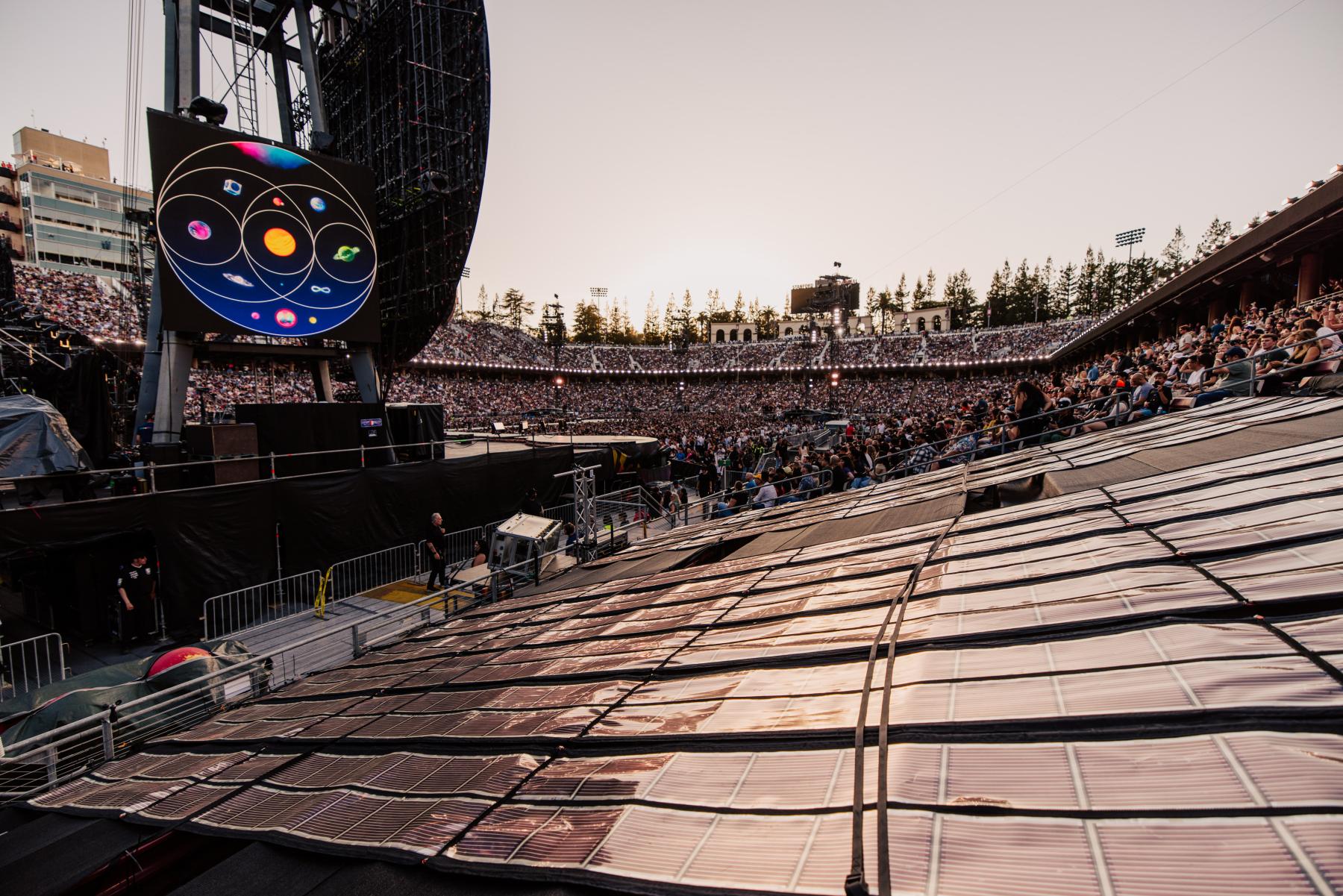
Image source: Anna Lee Media
Kardinia Energy is lighting up the global stage – literally.
The Newcastle-based solar energy company helped to decarbonise Coldplay’s world tour by powering one of their stages and other concert areas with printed solar panels. Now, with NSW Government funding, they’re creating a world-first commercial printed solar facility in Shortland which will help accelerate the deployment of this innovative technology.
Read on to see how Kardinia Energy’s printed solar panels are revolutionising solar energy.
What is printed solar?
Printed solar involves printing carbon-based inks on flexible plastic. These materials are abundant and do not require the energy-intensive manufacturing used to produce silicon panels, making it cheaper and more efficient to produce. Printed solar is fully recyclable in-house.
Kardinia Energy uses a roll-to-roll printing technique which is a similar method to printing newspapers. Kardinia Energy’s solar panels use organic photovoltaic (OPV) materials, consisting of organic semi-conducting polymers on recyclable polyethylene terephthalate (PET) plastic. This method can be scaled up rapidly either domestically or internationally.
Kardinia Energy’s co-founder and CEO, Anthony Letmon said printed solar offers a sustainable way to generate energy where traditional panels are not practical.
‘It enables a new way of thinking of solar energy. We’re printing sustainable energy that’s accessible to everyone,’ he said.
‘Unlike traditional solar panels, printed solar is lightweight so it can be applied to almost any surface, like an industrial roof that can’t handle the weight of traditional solar panels.'
The origin of printed solar
Paul Dastoor, a physics professor at the University of Newcastle’s Centre of Organic Electronics, has been researching the technology of semiconducting polymers for decades.
He and his team at the Centre for Organic Electronics have been manufacturing the technology on-site at the University of Newcastle since 2012, supported by the Newcastle Australian National Fabrication Facility Hub.
In 2020, Professor Dastoor partnered with Kardinia Energy to commercialise the solar technology.
From concept to implementation on the world stage
During Coldplay’s world tour, the team showcased their innovation by rolling out printed solar panels in stadiums globally.
The printed solar panels were placed behind the seats, behind the stage and elsewhere in the venue, collecting power in battery packs. The packs were then used to power the C stage and fulfil ancillary power needs throughout the venue.
The collaboration came about after Coldplay reached out with a bold goal – to reduce their tour’s carbon emissions by 50%. The team were unsure how it would work, but it proved to be a major success and demonstrated the potential of printed solar. This successful pilot project shows a blueprint for full-scale deployment across diverse industries and applications, including live entertainment, humanitarian and disaster relief.
‘It is the largest ever deployment of mobile solar of this scale and our Coldplay partnership has triggered lots of interest from other large international events,’ Letmon said.
Commercial manufacturing facility in the Hunter
Kardinia Energy has been awarded a grant to establish a commercial printed solar manufacturing facility in Shortland, Newcastle. The grant is part of the NSW Government’s $26.2 million Clean Technology Innovation grants program which aims to accelerate cleantech in NSW. Kardinia Energy is one of 13 projects across the state to receive funding support to advance its technologies from research to commercial business.
Letmon said this project could provide huge opportunities for the Hunter region and NSW.
‘The opportunity to develop a technology or invention into an industry could be quite powerful. We envisage a large-scale printing facility in Newcastle which has enormous opportunity to create jobs in the region and NSW.’
To learn more about net zero in the Hunter, visit our Hunter page.